Road Transportation
Lagos-Ibadan Expressway: From Eight-Hour Gridlock to Industrial Corridor — Why Nigeria Must Build Another Highway

Published
2 hours agoon
By Tijani Bankole
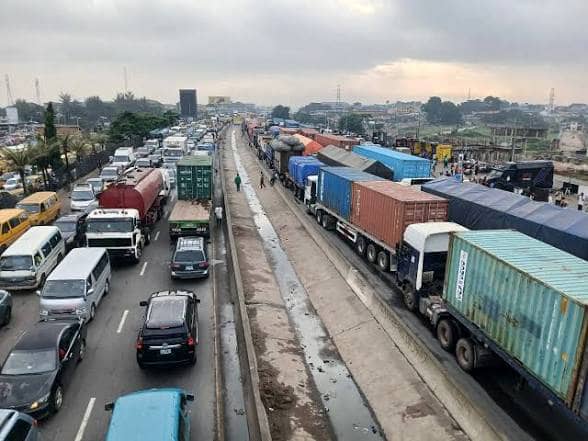
For a motorist who once spent eight agonising hours trapped in traffic on the Lagos-Ibadan Expressway, the journey between Lagos and Ibadan is no longer simply a matter of distance. It has become a test of patience, endurance and survival.
What should ordinarily be a journey of a few hours can turn into an exhausting day-long experience, with motorists stranded under the scorching sun, passengers missing important appointments, commercial drivers losing valuable working hours and businesses counting the cost of delayed deliveries.
For some, the nightmare begins around Mowe or Ibafo in Ogun. For others, it stretches from the Kara Bridge axis towards Berger, with no certainty about when the traffic will ease.
A broken-down truck, fallen container, overturned tanker or minor road accident can bring thousands of vehicles to a standstill, turning an important economic highway into a massive parking lot.
Yet, beyond the frustration and economic losses lies a bigger question: Has the Lagos-Ibadan Expressway outgrown its original purpose?
The 127.6-kilometre highway, which connects Lagos, Ogun and Oyo States, remains one of Nigeria’s most important transportation routes. It links the nation’s commercial capital and major seaport gateway with industrial centres, agricultural communities, markets and other parts of the country.
It carries virtually everything that sustains economic activities along the corridor — from food products and industrial raw materials to petroleum products, imported goods and manufactured items.
But the highway’s growing importance has also exposed its greatest weakness: too many competing transportation demands on one road.
Private motorists, commercial buses, intercity passenger vehicles, fuel tankers, container trucks, trailers and other heavy-duty vehicles now compete for limited road space.
The situation raises a fundamental question about Nigeria’s transportation planning: Should one highway continue to serve as the major passage for both industrial freight and millions of passengers?
Increasingly, the answer appears to be no.
From a pioneering highway to an overloaded economic corridor
When the Lagos-Ibadan Expressway was commissioned in August 1978 as Nigeria’s first intercity dual-carriageway, it represented a major milestone in the country’s transportation development.
It was designed to improve interstate connectivity, facilitate the movement of people and goods, and strengthen economic relations between Lagos and other parts of the country.
At the time, the scale of industrialisation, urban expansion and vehicular movement along the corridor was considerably different from what obtains today.
Over the decades, however, Lagos expanded rapidly, while neighbouring Ogun State emerged as an increasingly important destination for manufacturing companies, warehouses, logistics operators and industrial estates.
Communities such as Mowe, Ibafo, Sagamu and Ogere gradually developed into important residential, commercial and industrial locations.
The expansion brought jobs, investments and economic opportunities, but it also placed enormous pressure on the highway.
What was originally conceived as an interstate expressway has increasingly become a combination of an industrial access road, a freight corridor, a commuter route and a major intercity highway.
This convergence of transportation needs has created a difficult situation in which long-distance travellers must compete with local commuters, while heavy-duty trucks share road space with smaller vehicles.
The World Bank, in its April 2018 Nigeria Economic Update, identified the Lagos-Ibadan route as a strategic transport corridor and advocated a broader economic corridor approach involving coordinated infrastructure, industrial development and connectivity.
That recommendation deserves renewed attention as Nigeria confronts the growing transportation demands of its expanding economy.
When economic growth becomes a traffic burden
The increasing industrial presence along the Lagos-Ibadan Expressway is a welcome development for Nigeria’s economy.
However, industrial growth without corresponding transportation infrastructure can turn economic opportunities into logistical challenges.
Every day, trucks transport goods between factories, warehouses, distribution centres, Lagos ports and markets across the country.
These vehicles are essential to manufacturing, trade and national development. But when they operate on the same limited road space as millions of commuters and intercity passengers, the consequences become increasingly difficult to manage.
A single breakdown involving a heavy-duty vehicle can create kilometres of traffic. When a container falls or a tanker overturns, the situation can become even worse.
For motorists, the consequences go beyond wasted hours.
Fuel consumption increases as vehicles crawl through traffic. Engines and vehicle components experience additional wear. Drivers lose productive working hours, while businesses face delays, higher distribution costs and uncertainty in meeting delivery schedules.
For commercial transport operators, time lost in traffic translates into fewer trips, reduced earnings and higher operating expenses.
Passengers also bear the cost through missed appointments, delayed journeys and increased transport fares.
The economic implications are enormous. A road that should facilitate productivity can, under these circumstances, become a source of avoidable economic losses.
The case for retaining the existing road as an industrial highway
Rather than continue to stretch the existing expressway beyond its capacity, Nigeria should consider a fresh transportation strategy that reflects the changing economic realities along the corridor.
One option is to preserve and strengthen the existing Lagos-Ibadan Expressway as a major industrial and freight corridor.
This would involve a comprehensive redesign of its operations to accommodate the growing movement of heavy-duty vehicles and industrial goods.
Such a plan should include strategically located truck parks, rest areas, emergency response stations, weighbridges, cargo inspection facilities, improved drainage, adequate lighting and effective traffic surveillance.
There should also be stricter enforcement of vehicle roadworthiness, axle-load limits, speed regulations and parking restrictions.
Industrial estates, warehouses and logistics companies along the corridor should be incorporated into an integrated transport and land-use plan.
Properly designed access roads and service lanes would also help reduce the pressure created by vehicles entering and leaving industrial facilities.
The objective should be to ensure that goods move efficiently without unnecessarily disrupting other transportation activities.
However, retaining the existing expressway as an industrial corridor must not translate into excluding other road users. It should remain accessible, but its design and traffic management should give adequate attention to the heavy freight activities that increasingly define the route.
A second expressway: An investment in the future
The more ambitious and sustainable solution is for the Federal Government to consider constructing another expressway linking Lagos and Ibadan, primarily for passenger transportation.
The proposed highway would serve private motorists, commercial buses, intercity passengers and other commuters, reducing the pressure on the existing route.
It should be designed as a modern, high-capacity road with properly planned interchanges, controlled access, service roads, emergency facilities, adequate lighting and effective traffic management systems.
Its route should be determined through comprehensive feasibility studies, traffic projections, environmental assessments and consultations with affected communities.
Connections to major bus terminals, railway stations, residential centres and regional roads should also be incorporated into the design.
A second highway would provide more than an additional transportation route. It would offer an alternative during accidents, maintenance activities and other emergencies that frequently disrupt movement on the existing expressway.
More importantly, it would allow the two highways to serve different but complementary transportation needs.
For a country seeking to expand industrial production, improve logistics and reduce the cost of doing business, such an investment should be viewed as economic infrastructure rather than merely another road construction project.
The human cost of living along the expressways
While the debate often focuses on interstate traffic and industrial transportation, the experiences of communities located along the expressway deserve equal attention.
For residents of Mowe, Ibafo and other developing settlements, the highway is not simply a route to Ibadan or Lagos.
It is their everyday connection to schools, hospitals, markets, workplaces and family responsibilities.
Poorly planned access points, inadequate service lanes and distant U-turn facilities have created additional difficulties for residents and motorists.
In interviews reported by *PUNCH* in August 2026, some motorists and residents complained about poor access to communities, distant U-turn points and the absence of adequate service lanes.
One resident, Awoyemi Oladidupo, said the long distance to designated U-turn points sometimes encouraged motorists to drive against traffic.
Another motorist, identified as Peter, warned that such practices were dangerous and urged drivers to use designated turning points.
These concerns highlight the need for a transportation plan that considers both long-distance travellers and people living within the corridor.
A new expressway must not become another barrier to community development. Proper access roads, pedestrian facilities, bridges and well-planned interchanges must be part of the design.
The needs of residents should not be sacrificed in the pursuit of faster interstate transportation.
Road safety: The danger of one incident paralysing thousands
The safety challenges on the Lagos-Ibadan Expressway further strengthen the argument for a comprehensive transportation overhaul.
Heavy-duty vehicles, particularly tankers and container trucks, require special attention because of their size, weight and potential risks when involved in accidents.
In January 2026, the GO FORTE Foundation called on the Federal Ministry of Works to address a recurring accident hotspot around the Mobil Filling Station and Otedola Estate access.
The foundation advocated a technical audit, speed controls, heavy-vehicle lane management, escape ramps, improved road signs, lighting and stricter enforcement of weight limits.
These recommendations point to a wider problem that cannot be addressed through road construction alone.
Nigeria needs stronger vehicle inspection systems, responsible driving practices, effective cargo management, strict enforcement of traffic regulations and well-equipped emergency response teams.
In September 2026, *Channels Television* reported that a fallen container-laden trailer around Kara Bridge left motorists stranded for hours.
Similarly, BusinessDay reported in January 2026 that a collision involving two heavy-duty trucks around Otedola Bridge trapped commuters in traffic for hours.
Such incidents demonstrate how vulnerable the entire transportation corridor has become.
It is unacceptable that an accident involving one or two vehicles should bring the movement of thousands of people and businesses to a standstill for several hours.
A modern highway system should have adequate emergency access, effective incident management and alternative routes to minimise the impact of accidents.
Rail transportation must complement the roads
Although constructing another expressway could significantly improve road transportation, Nigeria must avoid treating road infrastructure as the only solution to its mobility challenges.
The Lagos-Ibadan railway already provides an alternative for passenger movement between the two cities.
With improved frequency, accessibility, affordability and operational efficiency, rail transportation could move thousands of passengers without adding more vehicles to the expressway.
Freight rail development would also provide an opportunity to move some heavy industrial goods away from the roads.
An integrated transportation system combining passenger rail, freight rail, an industrial highway and a separate passenger expressway would offer a more sustainable approach.
This is particularly important as Lagos and Ogun continue to attract manufacturing investments and experience rapid population growth.
In an editorial published on Sept. 29, 2026, *PUNCH* also highlighted the potential of rail transportation in reducing pressure on the expressway.
The message is clear: Nigeria needs a transportation network in which roads and railways complement one another rather than compete for limited capacity.
**Funding the proposed highway**
The construction of another Lagos-Ibadan Expressway will undoubtedly require substantial financial resources.
Given the scale of the proposed investment, the Federal Government could explore a combination of public funding, private-sector participation, public-private partnerships and infrastructure financing arrangements.
However, the project must be preceded by credible feasibility studies, realistic cost estimates, transparent procurement processes and clearly defined construction and maintenance arrangements.
The Lagos, Ogun and Oyo State governments must also be involved in the planning process because of the implications for land use, community development, industrial expansion and environmental protection.
Affected communities must be consulted, while adequate measures should be taken to minimise displacement and protect the environment.
Nigeria cannot afford another ambitious infrastructure project that becomes abandoned because of poor planning, inadequate funding or political changes.
The proposed highway must be economically viable, technically sound and sustainable over the long term.
The road to a new transportation vision
The Lagos-Ibadan Expressway has served Nigeria for decades. It has supported trade, connected communities, facilitated industrial development and strengthened economic relations between the South-West and other parts of the country.
But the demands placed on it today are significantly different from those of 1978.
Its growing importance should not be a reason to continue imposing multiple transportation responsibilities on one highway without considering alternative infrastructure.
The Federal Government should, therefore, commission a comprehensive feasibility and traffic study for a second Lagos-Ibadan expressway, while simultaneously developing a clear operational framework for the existing road as a major industrial and freight corridor.
A stakeholders’ forum involving transport economists, engineers, road safety agencies, manufacturers, freight operators, logistics companies, motorists’ associations, transport unions and the governments of Lagos, Ogun and Oyo States would provide an important starting point.
The discussions should focus on how to improve passenger mobility, facilitate industrial transportation, reduce road accidents and support the economic development of communities along the corridor.
Ultimately, the objective is not simply to build another road. It is to create a transportation system that allows people and goods to move safely, efficiently and predictably.
For the motorist who has spent eight hours in traffic, the argument is not theoretical. It is about reclaiming valuable hours of life.
For the manufacturer, it is about moving raw materials and finished products without unnecessary delays.
For the commercial driver, it is about making more productive trips and earning a sustainable income.
For the communities along the corridor, it is about having roads that support rather than obstruct their daily lives.
The Lagos-Ibadan Expressway should not become a victim of the economic growth it was built to support.
Nigeria does not need to abandon the old highway. It needs to rethink its purpose, maximise its industrial value and build another route that responds to the transportation demands of a modern economy.
The time has come to separate the movement of industrial goods from the growing demands of passenger traffic. Keep the existing expressway working for the economy, build another for the people, and let both drive Nigeria’s development.
Comrade Tijani Bankole is an urban development consultant, public affairs commentator, and newspaper columnist.