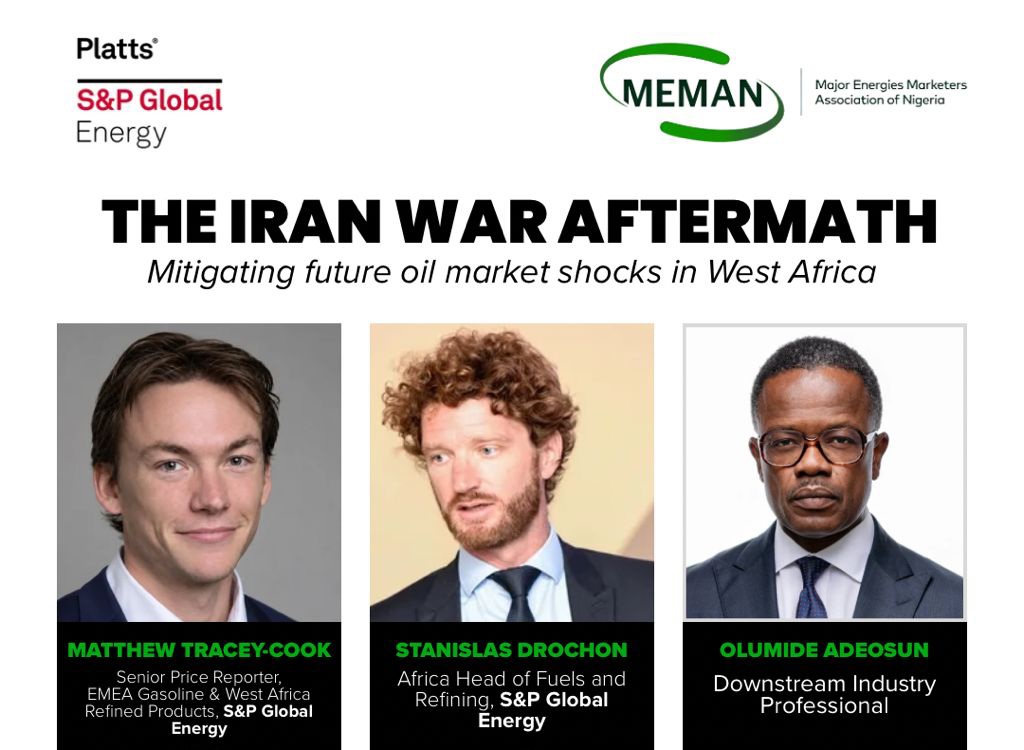
The Major Energies Marketers Association of Nigeria (MEMAN), in partnership with S&P Global Energy, thursday hosted a high-level webinar titled “The Iran War Aftermath: Reading the Tea Leaves — Mitigating Future Oil Market Shocks in West Africa.”
The webinar brought together industry experts, market analysts, regulators, and stakeholders to examine the geopolitical shocks affecting global energy markets and the implications for West Africa, with particular focus on supply security, pricing volatility, and long-term energy resilience.
Speaking during the session, presenters underscored the need for West African countries to strengthen their energy systems against future disruptions by prioritizing three major strategic actions: building domestic refining capacity, developing strategic stock, and deepening and expanding alternative energy options, including greater utilization of gas resources.
A key presentation referenced a reset in global energy priorities, where energy security, affordability, and sustainability are increasingly being weighed against one another. The discussion emphasized that, in Africa, the energy transition must remain a just transition, one that recognizes the continued relevance of fossil fuels in the short to medium term while accelerating the deployment of cleaner and more diversified energy solutions.
According to the webinar, the recent geopolitical disruptions served as a reminder that energy security is not only an economic concern but also a national security imperative. Speakers noted that countries with stronger refining systems, adequate reserve stock, and diversified supply sources are better positioned to withstand external shocks and protect consumers from sudden market volatility.
The three major policy directions highlighted during the webinar focused on
Building Domestic Refining Capacity, Expanding local refining capability to reduce dependence on imported refined products and strengthen regional self-sufficiency.
Strategic Stock Development
Establishing and maintaining strategic reserves to provide a buffer against global supply disruptions and short-term market shocks.
Deepening and Expanding Alternative Energies
Accelerating investment in cleaner and alternative energy sources, while prioritizing locally sourced options such as gas and biofuels to improve energy access, affordability, and resilience.
The webinar also examined market pricing trends, supply chain vulnerabilities, and the role of regional collaboration in stabilizing energy markets across West Africa. Industry participants agreed that stronger policy coordination, improved infrastructure, and diversified energy investments will be essential to building long-term market stability.
MEMAN on it’s part reaffirmed the association’s commitment to advancing transparent market development, supporting policy dialogue, and promoting practical solutions that strengthen Nigeria’s and West Africa’s energy future.
In his closing remarks MEMAN’S executive secretary, clement Isong noted that the quarterly webinar series by the association is one designed to constantly engage industry stakeholders on the developments in the sector with a view to bringing experts views to the table to solve challenges and drive growth within the oil and gas sector. He noted that the date for the next quarterly webinar would be announced in due course.