Energy Policy
Decade Of Gas Program: Spotlighting Achievements (2023-2025) In Two Years, As Nigeria Targets Gas-Powered Economy By Year 2030.


Published
9 months agoon
The decade of gas program was initiated and launched on March 29, 2021 under former President Mohammadu Buhari to drive Nigeria’s growth and transform her into a gas-powered economy by the year 2030.
Seen by many at the time as an ambitious project unlikely to deliver and meet its targeted purpose by 2030, given what many stakeholders say was obvious lack of preparedness by the government to explore the huge potentials in the nation’s abundant gas resources. The story is however changing in the last two years 2023-2025 of the president bola ahmed tinubu’s administration with the coming on board of minister of petroleum resources, gas, in the person of right honourable, ekperikpe ekpo under whose ministry the decade of gas program is being coordinated. Since coming on board some specific achievements have been made to getting Nigeria closer to making her a gas-powered economy ahead of the 2030 deadline.
This piece by the editorial team at energy news stream aims to spotlight some of these significant achievements by the ministry of petroleum resources as it relates to the decades of gas program.
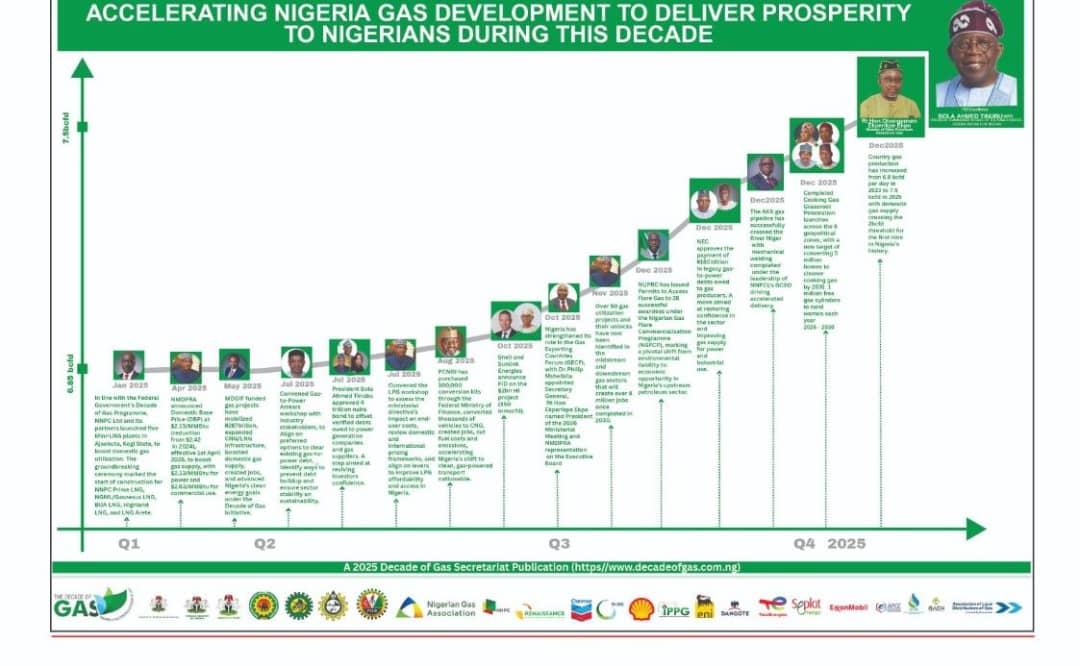
In the last two years of the tinubu’s administration, there has been significant increase in gas production, in the years under review, Nigeria’s gas production has increased from 6.8bcfd per day in 2023 to 7.5bcfd in 2025 with domestic gas supply crossing the 2bcfd threshold for the first time in Nigeria history.
Over 1bcfd of additional gas supply has been unlocked via final investment decisions and firm gas supply agreements with export gas volumes returning to 2021 levels.
One other area of achievement is the improved confidence in the gas to power sector. The presidential approval for settlement of approximately N185Bn(equivalent of over $500 mln) outstanding 12 year debt owed to gas producers providing gas supply in the Nigerian power sector has helped to sustain this confidence. In the last two years, Upstream Investment has also increased remarkably: Reports indicate that three final investment decisions- iseni, ubeta, and Hi achieved between 2023-2025 demonstrate renewed sector-wide investor confidence, and representing over $2billion mobilised toward a $30billion investment target by the year 2030.
Within this period Nigeria has also strengthened its global gas advocacy leadership, securing top-tier leadership positions within the gas exporting countries forum(GECF), these positions include president of the GECF Ministerial meeting (2026), Secretary-general of the GECF, and also the NMDPRA representation on the executive board.
Domestic base price is another significant achievement in the year 2025, as the country witnessed a reduction in the domestic gas base price from $2.42/mbtu to $2.13/mbtu reflecting efforts to maintain affordability while supporting continued investment. Issuance of a ministerial directive on the other hand mandating increased LPG production to deepen supply to Nigerian households and 2 pilot export redirection programs launched in 2025 under the cooking gas (LPG) grassroots penetration programme marks another remarkable achievement.
On the midstream and downstream gas infrastructure fund(MDGIF), a governing council approval was secured to finance over 20 critical gas infrastructure projects essential to sector expansion representing over 287 billion naira investment with over 50% already disbursed with projects at various phases of construction.
Progress is also been made according to findings by energy news stream on key infrastructure delivered by the NNPCL including the akk line River crossing and mechanical welding completion, with ELPs pipeline availability reaching over 90% in 2025 supplying gas to industries with OB3 crossing completion now planned for 2026.
It is expected that the identification of over 50 gas utilization projects in the midstream and downstream gas sectors will potentially help create over 4 million jobs once completed in the year 2030.