
Energy Policy
TBI Energy Conference: NMDPRA Projects $30billion In New Investment By Year 2030 As Country Attains 65% Domestic Refining Capacity


Published
1 hour agoon
Nigeria has crossed a major milestone in domestic refining, with local refineries now supplying about 65 per cent of the country’s petrol consumption in September, the Nigerian Midstream and Downstream Petroleum Regulatory Authority (NMDPRA) has said.
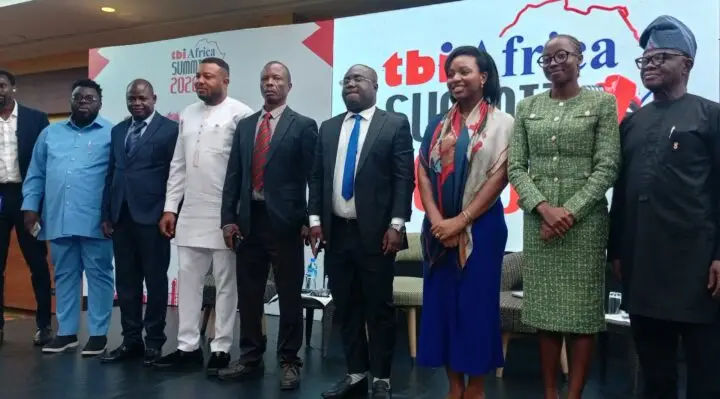
The Authority’s Chief Executive, Engr. Rabiu Abdullahi Umar who was represented by Engr. Victor Ojiakor disclosed this while delivering his address at the business intelligence africa conference, which was held in Lagos on thursday, 26th, November, 2026.
Umar said domestic refining capacity has grown substantially, and Nigeria has moved beyond processing products for domestic consumption alone.
“Now, finally, we have not just processed products for our domestic consumption; Nigeria is also exporting refined petroleum products to other countries.” The authority chief executive said.
He attributed the progress to a working regulatory environment and increased competition, which he said has ensured increased participation in the market and greater opportunities for investment.
In September, according to him, Dangote Refinery processed approximately 689,000 barrels of crude oil per day, operating at about 106 per cent of its installed capacity.
Umar, however, noted that Nigeria still requires supplementary imports to meet domestic petrol demand.
“It is important to note, however, that Nigeria still requires supplementary imports to meet domestic petrol demand.”
The authority chief executive who stressed that all products supplied in Nigeria must meet applicable product specifications, including prescribed sulphur content requirements said despite the achievements Nigeria still has gaps to close because they have to do with energy security.
“Our stock sufficiency is about 23.9 days for PMS, while LPG stock sufficiency is approximately 15.9 days. However, our target is 30 days of sufficiency.”
“What this means is that, in the event of a global shock, like the Iran-US conflict or any other international crisis, we must have sufficient stocks to cater for unexpected situations.”
“We have to build our national strategic stock to provide a buffer against the effects of global shocks.” He further clarified
Umar also noted that LPG demand is now growing, with almost four LPG storage facilities located along the southern coast.
Umar who also listed concrete opportunities, including gas processing and energy expansion, storage — especially in the northern part of the country as part of ongoing steps by government to develop the sector said the OB3 pipeline, the ELPS Midline Compressor and the Ajaokuta-Kaduna-Kano (AKK) pipeline are making progress towards completion. Referrencing the regulator’s August 2026 infrastructure update, he disclosed that the OB3 pipeline was about 96 per cent complete, while the ELPS Midline Compressor was approximately 96.33 per cent complete and the AKK pipeline about 88 per cent complete.
“We also have our national strategic stock, which we are piloting at NNPC depots in Suleja. It is meant to serve as a buffer for us to cushion the effects of global shocks.”
“We are piloting the scheme. We have selected some NNPC inland depots in three cities, and it is going to cut across the nation at large.”
“The essence is to have these products stored strategically in different parts of the country so that whenever an energy shock happens, no part of the country will be left behind. The country will be well supplied for a number of days, with a target of 30 to 45 days.” He stated.
On sustainability, Umar said Nigeria needs access to energy that Nigerians can afford — cleaner energy that people can afford and industries can rely on while saving costs.
“Every home using gas for cooking and every vehicle running on CNG lowers costs for the people.”
He said NMDPRA is already partnering Pi-CNG and the Midstream and Downstream Gas Infrastructure Fund (MDGIF) to bring mother stations and daughter stations closer to last-mile consumers.
About 20 universities, according to him, are targeted under the CNG daughter station programme. Several stations have already been commissioned, including those in four South-West universities, he disclosed.
“The essence is to leverage the ease of transportation and bring cleaner and more affordable energy closer to consumers.”
He also announced that Nigeria is introducing ethanol blending, another form of petrol.
“We are piloting ethanol blending through ethanol obtained from agricultural products to reduce emissions without displacing food crops or clearing forests.”
“This is intended to save foreign exchange and open a new market for Nigerian farmers.”
He added that NMDPRA will advance cleaner energy through gas expansion and sustainable production of biofuels and be as transparent as possible with regular industry data to ensure every data point released is proven and accurate.
“No regulator can secure a nation’s energy future alone. It requires partnership and teamwork.”
“We therefore call on all stakeholders, operators, financial operators, host communities, security agencies and development partners to join us on this journey to make the midstream and downstream industry sustainable, robust and effective.”
“Nigeria has shown that it can refine petroleum products domestically and supply neighbouring countries.”
“Our next task is to make that security clean enough, and good enough to power a new era of industry and growth.” The authority chief executive concluded.
Earlier and while welcoming participants to the summit, the convener and publisher of TBI Africa, Emeka Ugwuanyi said the gathering comes at a defining moment in Nigeria’s energy journey.
He noted that the theme of the TBI 2026 energy security and sustainability summit “Securing Nigeria’s Energy Future: Balancing Energy Security, Sustainability and Economic Growth” speaks directly to one of the most consequential issues confronting the nation today.
“Energy is not merely another sector of the economy. It is the foundation upon which industrialisation, economic competitiveness, job creation and national development rest. From manufacturing and agriculture to transportation, healthcare, education and digital innovation, the availability of reliable and affordable energy determines, to a significant extent, how far an economy can grow.”
“For Nigeria, therefore, securing our energy future is not just an industry aspiration; it is an economic and national imperative.” The convener said.
Nigeria, according to him, is richly endowed with oil, natural gas, renewable energy resources, and significant human capital, but regretted that despite these enormous advantages, the country continues to grapple with persistent energy access challenges, inadequate infrastructure, investment constraints, financing difficulties and the need to create a stable and predictable policy environment.
In the petroleum sector, he pointed to the transition towards a more competitive and investment-driven industry, driven by the implementation of the Petroleum Industry Act (PIA), the emergence of new industry players, increasing participation of indigenous companies and renewed efforts to expand domestic refining capacity.
“However, we must acknowledge that the journey is far from complete.”
“Nigeria must find practical and sustainable solutions to increasing crude oil production, attracting long-term capital, developing its gas resources, expanding domestic refining capacity and ensuring that the benefits of our natural resources translate into tangible improvements in the lives of citizens.” He noted
Mr. Ugwuanyi said same urgency towards reforms in the oil and gas sector applies to the power sector, declaring that despite successive reforms and investments, millions of Nigerians and businesses continue to contend with unreliable electricity supply.
“This situation imposes enormous costs on households, manufacturers and small businesses, undermining productivity and weakening our competitiveness.”
“The success of our energy reforms must ultimately be measured not by the number of policies announced or regulations introduced, but by improved energy access, greater reliability, affordability and the capacity of businesses to operate competitively.”
On sustainability, the Convener said Nigeria must position itself strategically to participate in the emerging energy economy without compromising its immediate development priorities.
The global push towards cleaner energy, decarbonisation and responsible resource utilisation presents both opportunities and challenges for a country whose economy remains significantly dependent on hydrocarbons.
“Our position must be informed by pragmatism.”
“We must pursue a transition that recognises Nigeria’s peculiar circumstances, development needs, and resource endowments. Natural gas, in particular, has a strategic role to play in supporting industrial growth, strengthening power generation and providing a pathway towards a more diversified energy mix.”
Achieving this balance, the summit convener said this will require more than just good intentions, but substantial investment, transparent and consistent policies, effective regulation, technological innovation, local capacity development and stronger partnerships between the public and private sectors.
As convener and publisher of TBI Africa, he said credible information, informed conversations, and constructive engagement remain at the heart of the media publication given the relevance of these elements in shaping the future of the energy industry.
“TBI Africa was established with the conviction that the energy sector needs platforms that bring stakeholders together, amplify informed perspectives, promote accountability and contribute meaningfully to policy and industry development.” Mr Ugwuanyi explained.

NMDPRA Hails NLNG, Backs Train 7 Expansion To 30 MTPA As Authority Chief Visits Bonny Island Plant

Uganda woos Dangote for $multi-billion Hoima refinery, fertiliser, salt projects


TBI Africa Energy Conference Holds Nov.26, 2026 As Stakeholders Set To Discuss New Roadmap For Sector

NMDPRA Demonstrates Regulatory Depth With Broad Participation At OTL Energy Week 2026

OTL 2026: NMDPRA, Ghana, Others Move To Harmonise Fuel Specs Across West Africa

OTL 2026: NMDPRA, Ghana, Others Move To Harmonise Fuel Specs Across West Africa