
Oil and Gas Industry
OTL2026: President Tinubu commits to functional refineries as stakeholders applaud downstream growth


Published
16 hours agoon
Report By Anthony Ebigie, Lagos, Nigeria
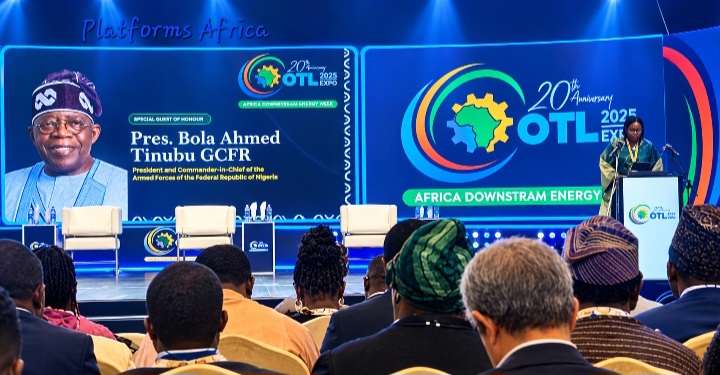
President bola tinubu has commended organisers of OTL african downstream energy week at the special occasion marking the 20th Anniversary of the annual gathering of industry stakeholders who have continuously in the last two decades showed commitment towards advancing conversations to drive growth in the downstream sector of the petroleum industry.
President Bola Tinubu who was represented by permanent secretary in the federal ministry of petroleum resources, patience oyekunle gave the commendation at the official opening of the 2026 edition of the OTL african energy week which opened in Lagos on Monday, 26th.
President Tinubu who noted that twenty years is not merely a milestone said the OTL 20th anniversary is a testament to the organiser’s resilience, relevance and sustained commitment to the development of Africa’s energy industry.
“I therefore commend the Board and Management of OTL Africa for creating and sustaining a platform that has consistently brought Government, investors, operators, regulators and other stakeholders together to deliberate on the future of our energy sector” the President said
President bola tinubu who also noted that this year’s gathering comes at an important moment in Nigeria’s economic journey said his administration is already transforming the petroleum industry from a sector that is largely import dependent characterised by infrastructure constraints into one that is now increasingly driven by domestic refining, private investment, market efficiency, value addition and regional competitiveness.
The reforms under the Petroleum Industry Act according to the President are designed to create a petroleum industry that is transparent, commercially viable, investment-friendly and capable of delivering value to Nigerians.
“Today, we are beginning to see the results. Nigeria’s crude oil production has been strengthened significantly” the President also said.
Speaking further the President also stated that in October, 2026, the country produced an average of approximately 1.50 million barrels per day of crude oil and 1.82 million barrels per day including condensates, maintaining compliance with the country’s OPEC quota for the fourth consecutive month. This progress the President declared demonstrates possibilities when regulatory predictability, operational efficiency and investor confidence work together.
The President noted that for too long, the country exported crude oil and imported a substantial proportion of the petroleum products required to power its economy, declaring that his administration’s vision is different with one that intends to build an integrated energy economy in which Nigeria’s crude oil and gas resources generate greater value at home through refining, petrochemicals, gas processing, manufacturing and other energy-intensive industries.
“The emergence of large-scale private refining capacity represents an important turning point. The Dangote Refinery has reached its 650,000 barrels-per-day nameplate capacity, strengthening Nigeria’s prospects of becoming a net exporter of refined petroleum products and creating new opportunities for regional supply” President Tinubu declared.
The President who also stated that his administration remains committed to ensuring that existing national refining assets are not allowed to become stranded investments said his government is currently pursuing a more rigorous, commercially sustainable approach to the rehabilitation and repositioning of the country’s refineries, supported by technical assessment, stronger partnerships and improved operational discipline.
“Our objective is clear: Nigeria must refine more of its crude, create more value domestically and become a reliable supplier of energy to Africa” the President further emphasised.
On gas president tinubu said Nigeria huge gas potential of about 215 trillion cubic feet reserves should be a major trigger to drive the country decisively from a resource-rich nation to a value-creating gas economy. “The recently unveiled Gas Master Plan 2026 sets ambitious targets of increasing national gas production to 10 billion standard cubic feet per day by 2027 and 12 billion standard cubic feet per day by 2030, while mobilising substantial investment across the value chain” the President noted.
Gas according to the President if well explored will power industries, support electricity generation, expand CNG and LPG utilisation, strengthen LNG exports and provide feedstock for petrochemicals and other gas-based industries.
Earlier in his opening remarks, Chairman of the OTL advisory board, Otunba adetunji oyebanji
Said the theme, “Secure Energy, Shared Prosperity”, speaks directly to the
purpose of downstream business. Reliable energy according to him enables factories to
produce, farmers to reach markets, aircraft to fly and households to earn a living.
Oyebanji also said that Nigeria’s commercial success can only have its fullest meaning when dependable
supply and productive investment improve the prospects of citizens and businesses.
Otunba oyebanji who acknowledged that when OTL began in 2007, much of Africa’s downstream discussion centred on securing imports, managing administered prices and
overcoming distribution constraints said though those concerns have not completely disappeared, the range of choices available to African businesses according to him has widened, and the continent’s capacity to shape its own supply
arrangements have strengthened.
“In West Africa, Ghana’s introduction of petroleum price liberalisation in
2015 marked an important stage in the development of a market with substantial private participation. Here in Nigeria, the emergence of largescale private refining, led by the Dangote Refinery, has changed the
possibilities for domestic supply and regional product trade. We now have a stronger basis for discussing how African refining can serve African markets competitively and reliably” he said
In East Africa, Kenya’s new Mombasa–Nairobi pipeline, completed in
2018, according to adetunji oyebanji has further strengthened a vital supply corridor. The development of petroleum links across Lake Victoria illustrates how infrastructure can extend the reach of coastal supply systems into neighbouring markets he further explained.
Despite years of downstream development, the chairman of the OTL advisory board however noted that there is still much to address. “Some markets remain heavily import dependent, infrastructure is uneven, and foreign exchange constraints
continue to complicate trade. Investment has not everywhere translated
into affordable supply” he said.
On his part governor babajide sanwo-olu was represented by his commissioner for energy and mineral resources said the state government under his watch prioritises energy as an important economic matter. The governor noted that since the start of the year 2026, his administration has encouraged the adoption of cleaner fuel for transport with the directive that public transport systems in the state run mandatorily on CNG or electricity, the governor said his administration has converted 152 first and last mile buses to CNG in furtherance to the commitment of his administration to cleaner energy adoption in the state.
The governor who also told the gathering that the state now regulates it’s own electricity market through the Lagos state electricity law and the Lagos state electricity regulatory commission said distribution in the state now operates under licences issued by the regulatory commission with the clear aim of ensuring better service for consumers a development the governor said has also created opportunity for private investment. “For industry, reliable power matters as much as reliable fuel” the governor declared.